Table of Contents
Understanding how to help someone with addiction usually means doing two things at once: staying close enough to matter while also refusing to make alcohol or drug use easier.
Those demands are pitted against each other. Families and friends feel the strain, and the advice they get often sounds contradictory.
This guide is for any person struggling with how to help someone with addiction. It covers California laws and research on alternatives to confrontation, along with what to have ready when someone says they are ready to get sober.
Can You Force Someone into Rehab?
For a competent adult in California, the short answer is no. You can’t sign a loved one into treatment the way you’d sign a child into school. Adults have the right to refuse medical care, including addiction treatment.
California has some legal options, but much of it is narrower than most people hope or expect.
- Involuntary Holds
- CARE Court
- Conservatorship
Involuntary Holds
California’s Lanterman-Petris-Short Act allows a short involuntary hold, commonly called a 5150, when someone is a danger to themselves or others or is gravely disabled. Substance use alone didn’t used to qualify.
Senate Bill 43, signed in 2023, widened “gravely disabled” to include people who, because of a severe substance use disorder, can’t provide for their own personal safety or necessary medical care.
Previously, counties could delay implementation until January 1, 2026. It now applies statewide, though practice still varies by county.
Law enforcement or designated clinicians can initiate a 5150. Families can’t. The hold lasts for a few days and addresses a crisis, but it doesn’t provide a treatment plan.
CARE Court
California’s CARE Act lets a family member petition a court to create a care plan for someone.
It may sound like the answer for how to help someone with addiction, but for most families dealing with substance misuse, it isn’t.
The CARE Act is for adults with untreated schizophrenia or other psychotic disorders. A co-occurring condition may qualify for some, although substance use addiction by itself doesn’t.
Conservatorship
Conservatorship is a long, expensive court process with a very high bar to clear and is mostly used for people who can’t care for themselves. It’s rare that it helps someone with addiction get into a 30-day rehab program.
California’s legal tools generally only address a crisis or psychiatric emergency. For a loved one who is functioning on their own and refuses treatment, the best option is persuasion.
What Works Better Than an Intervention
Most people perceive an intervention as a living room of friends and relatives reading letters, with a car waiting outside to take the person to rehab. That’s the Johnson Intervention. It was developed in the 60s and it usually works better on television than in real life.
A more effective alternative today is Community Reinforcement and Family Training, or CRAFT, and it has better evidence to back it up. It trains family members to change how they respond to the person using drugs or alcohol.
After about a dozen sessions, family members learn to stop reinforcing substance use, make sober time more rewarding, bring up treatment options when the person is more likely to listen, and how to keep the person safe.
In a randomized trial of 115 family members of people refusing treatment, 62% of the loved ones of family members trained in CRAFT entered treatment, compared with 37% for families who got 12-step facilitation instead.
When trying to help someone with addiction get into rehab, they were refusing treatment in both groups. The successful difference came entirely from what the family did.
With CRAFT, the family members providing help get trained and make changes first. That can be challenging but it gives them something to do.
Keep in mind, 62% isn’t perfect, and even the best approach doesn’t work every time. It’s certainly better than 37% and remember that instead of thinking you failed.
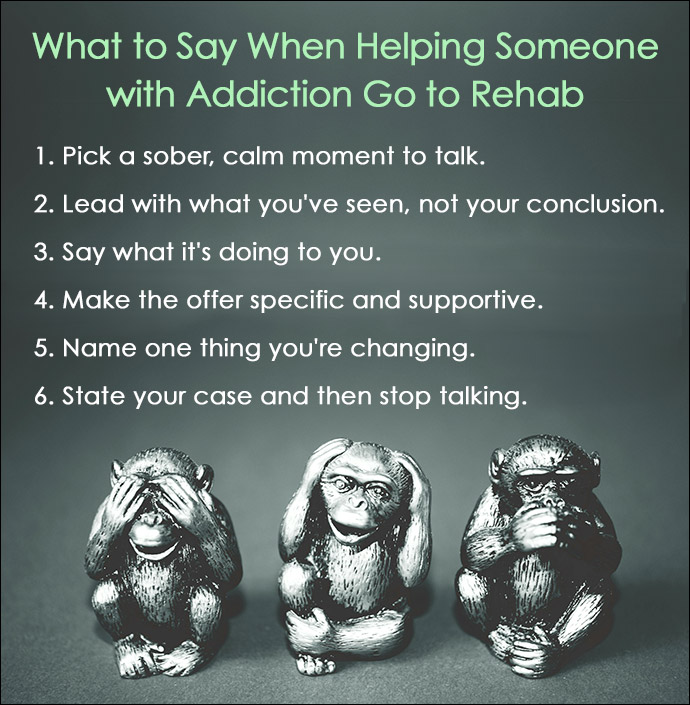
What to Say When Helping Someone with Addiction Get into Rehab
It’s important to choose the most appropriate time to talk. Having a conversation while a person is high or right after partying when they are hungover is almost never going to work. Timing matters more than what you say or how you say it.
Some things that tend to help:
1. Pick a sober, calm moment to talk.
Early in the day is often better than evening. Nobody comprehends or fully understands anything while intoxicated, experiencing a hangover, or in withdrawal.
2. Lead with what you’ve seen, not your conclusion.
“You were shaking at breakfast on Sunday” is harder to argue with than “you’re an alcoholic.”
3. Say what it’s doing to you.
Give them information they may not have realized on their own.
Don’t use it as a weapon because it defeats the purpose.
4. Make the offer specific and supportive.
“I called a place that can talk to you today, and I’ll drive you” gives them something positive to act on and shows you are being supportive.
“You need help” can feel threatening and almost never works.
5. Name one thing you’re changing.
State what you’ll do differently, like not enabling them anymore, without making a threat.
6. State your case and then stop talking.
Leave the room for an opening. You don’t need a confession.
Reading out grievances, raising it in front of their kids, arguing over whether they’re “really” an addict, and negotiating while they’re high almost always backfires.
A refusal doesn’t make the conversation a waste of time or mean it’s over and done. People rarely enter treatment the first time you bring it up. But it plants the seed and gives them something to think about so the next time they might be more receptive.
Summit’s post on the excuses people use to avoid treatment covers common objections so you can prepare for them.
Where Support Ends and Enabling Begins
Consider how and what your help protects them from.
Paying for groceries so a grandchild can eat is support. Paying a bar tab or repeatedly covering a DUI lawyer protects them from consequences. So does calling in sick on their behalf. The difference can be hard to perceive in the moment.
Before stepping in to help, ask whether you’re removing a consequence that would otherwise fall on them. If so, it’s probably enabling.
On the other hand, helping in a way that keeps someone safe or meets their basic needs is a form of support and not enabling.
Nobody gets this right every time. Families who have been providing positive or negative reinforcement for years are usually harder on themselves than they need to be.
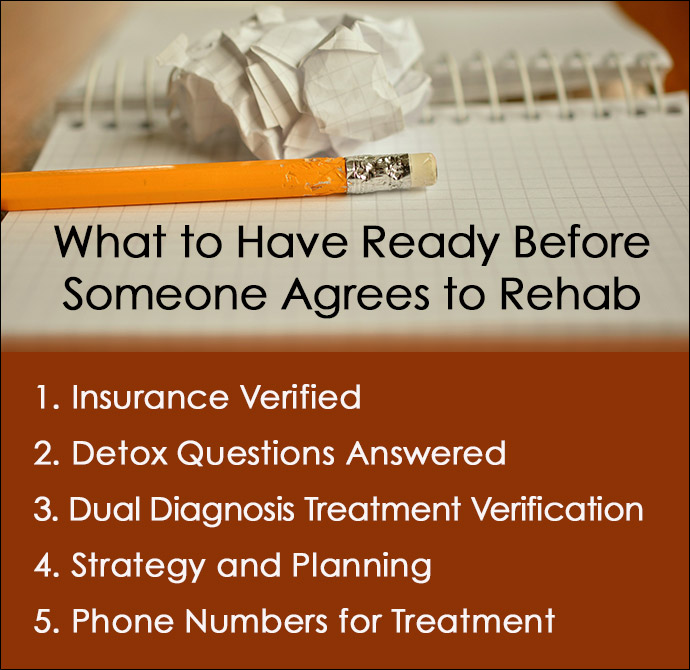
How to Be Ready Before They Agree to Help with Addiction
Families often skip the preparation, and it can be detrimental when someone finally agrees to help getting into rehab.
Someone who is ready to go to rehab on Tuesday might change their mind on Friday. A week spent making phone calls gives that willingness time to fade. Do the research and be ready while the answer is still No.
Items to have ready:
1. Insurance Verified
Know what the insurance plan covers before you need it. Most programs like Summit Malibu will verify insurance benefits for you without a commitment. It is quick and easy.
2. Detox Questions Answered
Alcohol and benzodiazepine withdrawal can be medically dangerous. Ask whether the program provides medical detox on site or it refers it out.
3. Dual Diagnosis Treatment Verification
If depression, bipolar disorder, PTSD, anxiety disorders, or other issues are also present, a dual diagnosis program treats addiction and mental health at the same time. Summit Malibu’s dual diagnosis program offers this type of care.
4. Strategy and Planning
Decide who drives, who handles work, who handles the kids, and what goes in the travel bag for rehab treatment.
5. Phone Numbers for Treatment
Have all necessary phone numbers ready to call. This includes the admissions team, doctor, therapist, and anyone else involved in the treatment plan.
Admissions teams are used to hearing from families before someone agrees to treatment. The call is free and doesn’t commit anyone to anything.
How to Help Someone with Addiction While They’re Still Using
Some people take months or years before agreeing to go to addiction rehab. Keeping them safe and alive while they’re still using drugs is the immediate goal.
If any type of opioid use is involved, including counterfeit pills, keep naloxone (Narcan) on hand and accessible. Families of someone with opioid addiction should keep naloxone nearby, ask their loved one to carry it, and tell friends where you keep it.
Even with naloxone available, you should still call 911 in the event of an overdose.
Naloxone is available as a nasal spray without a prescription in California. It has no negative effect if the person hasn’t taken opioids.
Know the signs of an opioid overdose:
- Unresponsive
- Slow or stopped breathing
- Blue or grey lips and fingertips
- Pinpoint pupils
- Someone on opioids who is snoring and won’t wake up isn’t simply asleep. Call 911.
Helping someone with addiction in this way is not giving up on treatment. It’s what keeps treatment possible.
Getting Help for Yourself
Families and friends of people with substance use addiction often reach a point of exhaustion after managing alone for longer than anyone realizes.
SAMHSA’s National Helpline is a free and confidential resource, open 24 hours a day, for families as well as for the person using, at 1-800-662-HELP (4357).
Al-Anon and Nar-Anon support groups for families of people with an addiction meet in most communities and they cost nothing to attend.
Individual therapy for a family member isn’t a luxury, though it usually gets treated as one.
Family work belongs in treatment itself, and Summit Malibu offers Strategic Family Therapy as an evidence-based approach to promote positive family relationships.
Remember, you didn’t cause this, and you can’t control it. Community Reinforcement and Family Training (CRAFT) gives you a way to influence what happens next.
How to Help Someone with Addiction FAQs
Can you put someone in addiction rehab against their will in California?
Usually, no, if addiction is the only reason. Adults in California have the right to refuse treatment. Short involuntary holds apply when someone is a danger to themselves or others or they are gravely disabled. SB 43 expanded that definition to include severe substance use disorder. Law enforcement or designated clinicians initiate those holds, which last days rather than weeks.
Does CARE Court work for drug or alcohol addiction?
Generally, no. California’s CARE Act serves adults with untreated schizophrenia spectrum or other psychotic disorders. Someone with a qualifying psychotic disorder and a substance use disorder may be eligible. Substance use alone isn’t enough.
How to help someone with addiction when they refuse help?
Keep the relationship on good terms, stop protecting them from consequences, make sober time more appealing, and ask again later. CRAFT teaches families these skills and gets more people into treatment than confrontation does. Keep naloxone (Narcan) in the house if opioids are involved and call 911 if an overdose occurs.
Should we do an intervention to get someone into rehab?
Maybe, but it shouldn’t be the first move. A surprise confrontation sometimes works but it can also damage a relationship you’ll need later. CRAFT and other family training approaches have stronger evidence for success. If you decide to try an intervention, use an experienced interventionist instead of organizing it on your own without professional help.
How do I talk to someone about their drinking without starting a fight?
Wait until they’re sober, describe what you have seen them do, explain how it affects you, and offer specific help. Then let it sit. One calm conversation is worth more than three arguments. Always offer love and support without pointing fingers or offering ultimatums.
Are You Struggling with Addiction?
Summit Malibu was created by people in recovery for people seeking to recover. We understand where you are now and how you can find lasting change.
Contact Us Today: (310) 742-1882